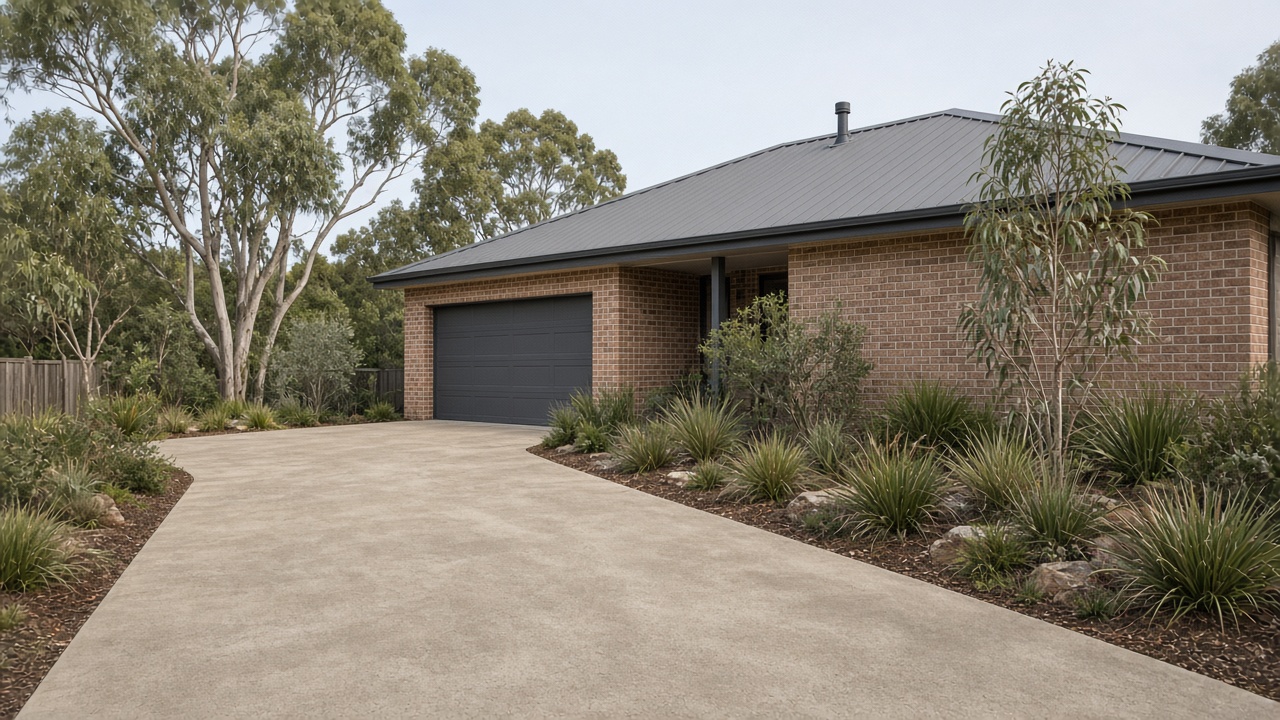
Coloured concrete in Koo Wee Rup
A through-coloured slab can warm up a Koo Wee Rup house without a busy pattern, as long as the colour is chosen in the real light of the street and the base is built for the ground.
Email: info@kooweerupconcreting.com.au
Colour that belongs next to brick and Colorbond
Coloured concrete is simply a pigmented mix, not a paint on top of a grey slab. Done well, it gives a quiet, even tone that sits comfortably against Australian brick, render and steel roofs. In Koo Wee Rup the light is often bright and a bit hard, and a colour that looked muted on a small sample can read stronger once it is a whole driveway. We bring larger samples to the property and look at them in sun and in shade, next to the actual house, before we lock a choice in.
Charcoals, sandstones and softer greys are the usual starting points here. Very bright or very red tones are easy to tire of, and they show dust differently. We will say so if a colour you like on a phone will fight the brick or make every leaf visible. The aim is a driveway or patio that still looks considered in five years, not only on the day the sealer goes on.
Through-colour, not a thin surface stain
There is a difference between colour in the mix and a coating painted on later. Through-colour goes all the way through the slab, so a chip or a sawcut still looks like the same material. A surface coating can look even on day one and then wear at the turning points. If you already have a sound grey slab and you want a new colour, we will talk about resurfacing as a separate option, with its own limits. For a new pour, we almost always recommend colour in the concrete itself.
Even through-colour is not a perfectly factory-flat shade. Concrete is a natural mix. Slight variation is normal and usually looks better than a plastic, uniform sheet. We finish the surface so the colour reads evenly, and we talk about sealer if you want more depth and easier cleaning.
Where coloured concrete works on this kind of block
Front driveways, patios, paths and some crossovers are the usual places. A coloured driveway can be paired with a plain broomed side run so the budget goes into the public face and the working edges stay honest. On farm entrances we are more cautious, because implements and mud are harder on a show colour. Sometimes the first section from the road is coloured and the rest is plain. The join has to be planned so it looks deliberate.
Falls, joints and base remain the same conversation as any other pour in this town. Colour will not hide a pond at the garage door or a slab that has been placed on peat. If anything, a consistent colour makes a dip easier to see. We still start with the ground.
Curing, sealing and keeping the tone even
Colour is sensitive to the way a slab cures. If one area dries much faster than another, you can get patches. We plan the pour for the weather, use the right protection, and avoid early traffic that can polish or mark a young surface. A sealer, when it is in the quote, should go on at the right time, not the afternoon of the pour. We will tell you when that is.
Cleaning is straightforward: a hose, a broom, and an occasional light pressure clean. Harsh acids and careless high-pressure work can change the look of a pigmented surface. We will give you simple care notes with the job, not a chemistry lecture.
Choosing a colour on a bright, flat Koo Wee Rup street
The light in this town is often hard and open. There are fewer hills to throw afternoon shade across a front yard, and many houses sit under a wide sky with a Colorbond roof and a simple brick face. A charcoal that looked gentle on a small wet sample can read almost black once it is a whole driveway. A sandstone that looked warm indoors can turn paler in this light, or pick up a yellow that fights a red brick. That is why we will not lock a colour from a phone photo alone.
On the visit we put samples on the ground, in sun and in shade, and we look at them against the actual brick, the window frames and the roof. We also talk about how the colour will show dust, irrigation marks and tyre film. Darker tones can look formal and then show every dry leaf. Very pale tones can look clean and then show every oil drip. Mid tones are often the most forgiving on a working driveway, which is most of the driveways we pour here.
If you already have a coloured path or a neighbour's driveway you like, we can use that as a starting point, with the honest caveat that weathered concrete and a new pour will not match exactly. A deliberate contrast, or a plain border around a coloured field, is sometimes a better design than a near miss.
Colour, joints and the way a slab is used
Colour makes joints and edges more visible, which is a good thing if they are planned and a poor thing if they are random. We mark joints to the shape of the driveway, including at the garage opening and at any change of width, so the lines look considered. A coloured slab with messy, late joints will always look like a job that was rushed, no matter how pretty the pigment is.
We also think about the meeting with a crossover. If the public crossing stays grey and the driveway is coloured, the boundary joint should be straight and confident. If both are coloured, we will talk about whether the same tone should run through or whether the crossing should stay a quieter grey, which is often the more durable public finish.
On the rural edge of town, coloured concrete is best used where it will be seen and cared for — the first section from the road, a courtyard, a path — rather than on a turning bay that will see implements and mud. We can design that split so it looks intentional, with a clean change of finish rather than a fade.
Aftercare that protects the tone
A coloured driveway needs a sensible first week. Keep animals and cars off until we say it is ready. Keep builders from stacking steel or a skip on a young surface. If a sealer is in the quote, let it go on at the right time. After that, cleaning is simple and regular, not aggressive. If you ever want to change the tone later, talk to us before you roll a coating over a through-colour, because a coating is a different system with a different life.
Koo Wee Rup soil, water and Cardinia Shire rules
Koo Wee Rup sits on land that was once a swamp, drained from the late nineteenth century so the township and the market gardens could exist. Under the grass you will often find peat, heavy clay, or a mix of the two, with a water table that can sit closer to the surface than it does in the hills. Peat can compress. Clay can shrink and swell with the seasons. A slab poured thin, straight onto that ground, will move with it.
We dig until we reach firm material, take out soft or wet soil, compact crushed rock in layers, set steel on chairs, and design falls so water leaves the house and the garage on this flat land. Winter rain can make compaction harder. A hot north wind can dry a finish too fast. We plan around both. Concrete inside your boundary rarely needs a council permit. Work in the road reserve — a crossover, a nature strip, a public footpath — can need Cardinia Shire's consent. A slab that will carry a building needs a building permit and, usually, engineering. Your quote spells out which of these apply.
How your Koo Wee Rup quote is put together
Every quote we send is written and itemised. It describes the area we measured, the excavation and where the spoil or old concrete will go, the compacted crushed-rock base, the slab thickness, the steel and how it will be supported, the finish, any sealer, and extras such as a drain, a step, a border or a new crossover. If Cardinia Shire or a building surveyor has to be involved, the quote names that rather than leaving it as a surprise.
The quote also describes the practical side of the pour: where a truck or pump would stand, how we protect gardens and fences, and how long the area needs to stay closed. If we think the ground may hide a problem — wet peat, an old slab, a pipe — we say so and explain how we would handle it. There are no prices on this website because two blocks in the same Koo Wee Rup street can need very different prep. The visit and the written quote cost you nothing.
What you get with Koo Wee Rup Concreting
Local to Koo Wee Rup 3981
We work the township first, then the hamlets and neighbouring Cardinia towns we actually drive to every week.
Built for peat, clay and flat ground
Deeper prep where the old swamp soil needs it, compacted bases, and falls that drain on land with almost no natural slope.
Free written quotes
Every job is itemised. No website rates, no pressure, and no charge to visit or to send the quote.
Shire-edge work handled clearly
Crossovers in the road reserve and any permit questions are named in the quote before we start.
Six steps to a finished job
- 1
Get in touch
Call, email, or send the form with a few photos of the area, the front of the property, and any tight gate.
- 2
Site visit
We measure, look at the ground, check levels and the crossover, and bring finish samples to hold against the house.
- 3
Written quote
You get an itemised quote covering digging, base, thickness, steel, finish, drainage and any shire or permit work.
- 4
Base and formwork
We remove failed concrete or topsoil, excavate soft material, compact the base, set the forms and place steel.
- 5
Pour and finish
Concrete is placed, levelled and finished, then protected while it cures in the week's weather.
- 6
Clean-up and care
We strip the forms, cut joints, take the rubble away, seal if it was quoted, and leave you care notes.
Coloured Concrete questions
Will the colour fade?
All outdoor materials weather a little. A good through-colour and a maintained sealer weather slowly and evenly. We will not tell you a driveway will look identical in fifteen years, but we will choose a tone and a finish that age honestly.
Can I colour only the border?
Yes, if we design it into the formwork. A contrasting band can look very sharp on a short township driveway. On a long rural entrance it can look fussy. We will help you decide on site.
Is coloured concrete slippery when wet?
A steel-trowel finish can be. We usually use a light broom, a texture, or a mix of finish and fall so the surface stays sensible in the wet. If you need more grip, we will talk about the finish rather than adding a later coating as a fix.
Where we work
Other concreting services
Talk to a Koo Wee Rup concreter
We visit, measure and put it in writing for work in Koo Wee Rup 3981 and the Cardinia towns around it. Nothing on this site is priced, because no two blocks are the same.