Concrete removal and replacement in Koo Wee Rup
When a Koo Wee Rup slab has failed, we break it out, take it away, and rebuild on a base that suits the peat or clay underneath — rather than pouring a new face on a known problem.
Email: info@kooweerupconcreting.com.au
Taking out what has already told you it is finished
Removal is the first day of a replacement job, and it should be done with the next pour in mind. We break out the failed concrete, cart it away, and then look at the ground it was sitting on. In this town that ground is often the real story: a thin slab on wet soil, little or no base, a crossover that was never right, or peat that has compressed under years of traffic. Once the old surface is gone, we can prepare the site properly instead of guessing through a crack.
We plan the demolition so you can still get to the house or the shed where possible, and so neighbouring surfaces and fences are protected. A tidy removal is not only courtesy. It is how we start the new job on a clean, understood site.
Partial removal versus taking the lot
If only one panel or the street end of a driveway has failed, we can sometimes remove that section and leave the sound concrete in place, with a proper joint at the meeting. If the whole entrance is moving, or if the remaining slab is too thin to trust, we will recommend taking it all. We would rather have that conversation before we start than discover halfway through that the 'good' section is no better than the bad one.
Old paths, failed pads and broken crossovers can be removed as part of the same visit if they are in the way of the new work. The quote will say what is coming out and where the rubble is going.
Building the new slab on what we find
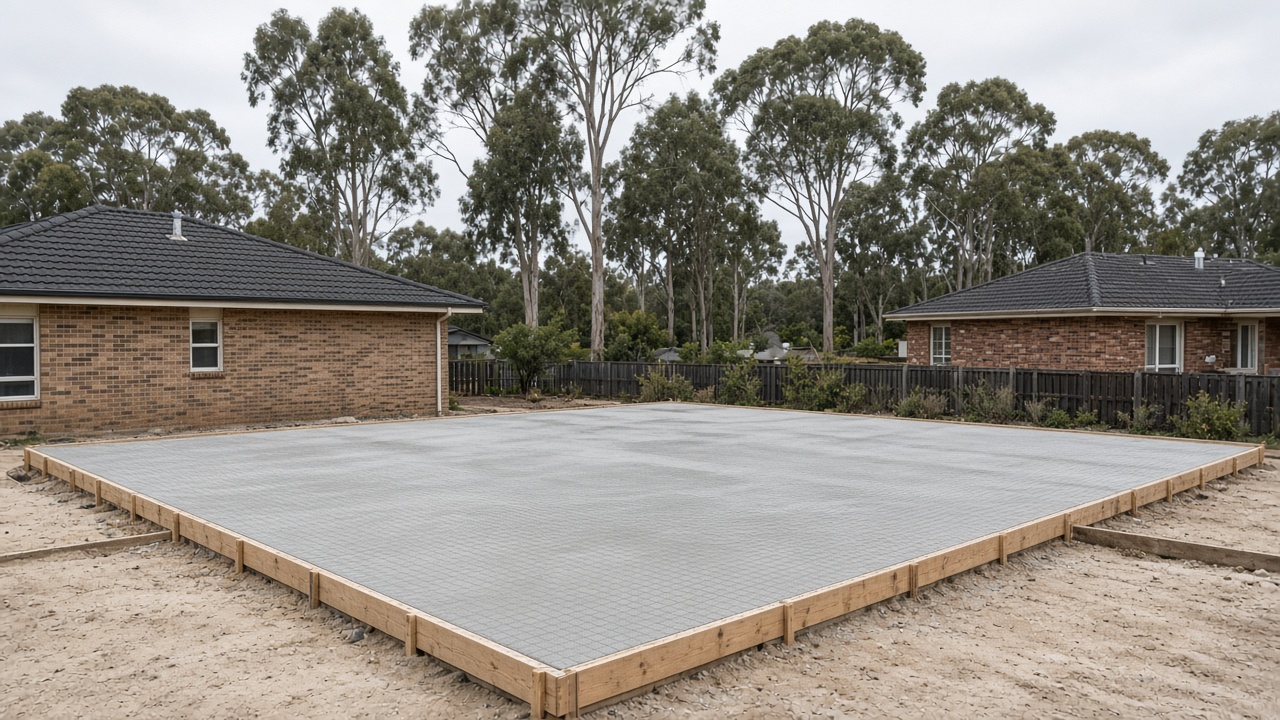
Once the old concrete is gone, we excavate as required, put in a compacted base, and pour the new slab to the falls and finish you have chosen. The advantage of a full replacement is that we are no longer inherited the old levels and the old mistakes. The advantage of a partial replacement is less disruption and less cost, if the remaining slab deserves to stay. We will recommend one or the other based on what we see, not on a preference for bigger jobs.
Taking out a failed slab without making the next job harder
Removal is not only a skip and a breaker. In Koo Wee Rup it is often the start of understanding why the old work failed. We look at the thickness, the base, the wet corners, and whether peat or poor fill is still under the job. If we only smash the surface and pour again on the same soft ground, we have sold you a second failure. The honest sequence is remove, inspect, prepare, then replace.
Access matters. A tight township driveway may need smaller plant and a careful plan for the street. A rural entrance may need a place for spoil that does not chew up a lawn or block a gate. We will talk about that on the visit, including how long the property will be without a usable entrance, because that is a real part of living through the work.
What we keep, and what has to go
Sometimes a path or a side slab is still sound and can stay, with a clean joint to the new work. Sometimes everything is tied together and the kind cut is to take it all. We would rather make that call on site than promise a 'just the front' removal and then find the remaining slab is already moving. Any meeting we leave has to be a meeting you can live with, not a trip or a crack waiting to open.
We also watch services. Old slabs sometimes hide a pipe, a cable, or a poorly placed pit. We work carefully and we will stop if something unexpected appears, rather than push on and hope.
Replacement as a complete job
The quote for removal should sit with the quote for the new slab, so you can see the whole sequence. A cheap break-up followed by a thin new pour is not a bargain on this ground. We will tell you what we expect to find, what might change if the ground is worse than it looks, and how we will leave the site. The aim is a clear run from the old failed surface to a new slab that has been given a proper base, not a messy gap between two separate jobs.
Planning the week without an entrance, and the new slab that follows
The most practical question on a replacement is often not the breaker. It is how you will live for the days between the old surface coming out and the new one taking traffic. We will talk about parking, a temporary way through if one is possible, and how long we expect that gap to last in ordinary weather. A township family and a farm gate have different answers, and both deserve a plan before we start.
Once the ground is open, the new slab should be designed for what we actually find, with a compacted base, proper thickness, planned joints and falls that work on this flat land. That is the point of a replacement. If you also want a different finish — exposed aggregate at the front, a tougher broom toward a shed — this is the moment to design it, not a season later. The quote should hold the removal and the new work together so you can see the whole week, not only the afternoon the old concrete leaves the street.
Koo Wee Rup soil, water and Cardinia Shire rules
Koo Wee Rup sits on land that was once a swamp, drained from the late nineteenth century so the township and the market gardens could exist. Under the grass you will often find peat, heavy clay, or a mix of the two, with a water table that can sit closer to the surface than it does in the hills. Peat can compress. Clay can shrink and swell with the seasons. A slab poured thin, straight onto that ground, will move with it.
We dig until we reach firm material, take out soft or wet soil, compact crushed rock in layers, set steel on chairs, and design falls so water leaves the house and the garage on this flat land. Winter rain can make compaction harder. A hot north wind can dry a finish too fast. We plan around both. Concrete inside your boundary rarely needs a council permit. Work in the road reserve — a crossover, a nature strip, a public footpath — can need Cardinia Shire's consent. A slab that will carry a building needs a building permit and, usually, engineering. Your quote spells out which of these apply.
How your Koo Wee Rup quote is put together
Every quote we send is written and itemised. It describes the area we measured, the excavation and where the spoil or old concrete will go, the compacted crushed-rock base, the slab thickness, the steel and how it will be supported, the finish, any sealer, and extras such as a drain, a step, a border or a new crossover. If Cardinia Shire or a building surveyor has to be involved, the quote names that rather than leaving it as a surprise.
The quote also describes the practical side of the pour: where a truck or pump would stand, how we protect gardens and fences, and how long the area needs to stay closed. If we think the ground may hide a problem — wet peat, an old slab, a pipe — we say so and explain how we would handle it. There are no prices on this website because two blocks in the same Koo Wee Rup street can need very different prep. The visit and the written quote cost you nothing.
What you get with Koo Wee Rup Concreting
Local to Koo Wee Rup 3981
We work the township first, then the hamlets and neighbouring Cardinia towns we actually drive to every week.
Built for peat, clay and flat ground
Deeper prep where the old swamp soil needs it, compacted bases, and falls that drain on land with almost no natural slope.
Free written quotes
Every job is itemised. No website rates, no pressure, and no charge to visit or to send the quote.
Shire-edge work handled clearly
Crossovers in the road reserve and any permit questions are named in the quote before we start.
Six steps to a finished job
- 1
Get in touch
Call, email, or send the form with a few photos of the area, the front of the property, and any tight gate.
- 2
Site visit
We measure, look at the ground, check levels and the crossover, and bring finish samples to hold against the house.
- 3
Written quote
You get an itemised quote covering digging, base, thickness, steel, finish, drainage and any shire or permit work.
- 4
Base and formwork
We remove failed concrete or topsoil, excavate soft material, compact the base, set the forms and place steel.
- 5
Pour and finish
Concrete is placed, levelled and finished, then protected while it cures in the week's weather.
- 6
Clean-up and care
We strip the forms, cut joints, take the rubble away, seal if it was quoted, and leave you care notes.
Removal and Replacement questions
Will my garden and fence survive the removal?
We work carefully and we protect what we can, but breaking out concrete on a tight township lot is still a physical job. We will tell you if a garden bed or a fence is likely to be disturbed, and we will make good what the quote says we will make good.
Can the new driveway go down the same week?
Often the removal, the prep and the pour are planned as a short sequence, weather allowing. Wet peat can slow the prep. We will not pour on a base that is not ready just to keep a calendar.
Where we work
Other concreting services
Talk to a Koo Wee Rup concreter
We visit, measure and put it in writing for work in Koo Wee Rup 3981 and the Cardinia towns around it. Nothing on this site is priced, because no two blocks are the same.