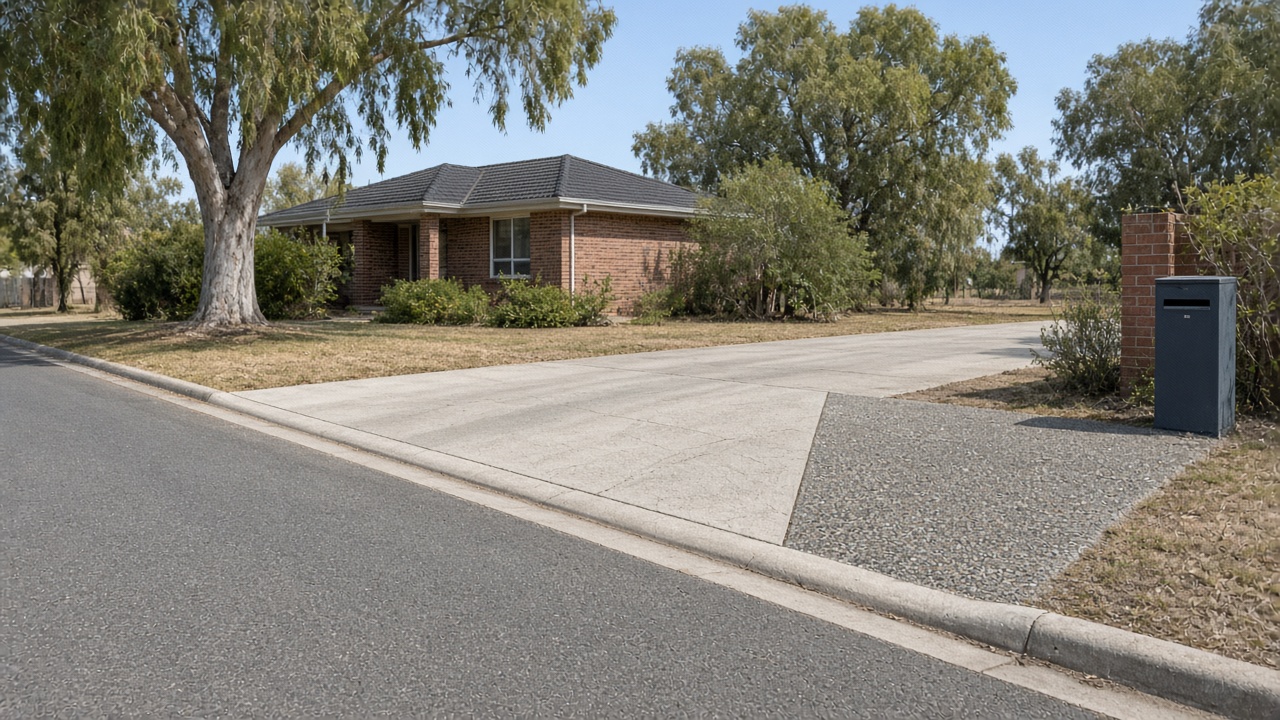
Concrete crossovers in Koo Wee Rup
The crossover is the public edge of your driveway: the section in the Cardinia Shire road reserve that has to meet the kerb, drain properly and stand up to street traffic.
Email: info@kooweerupconcreting.com.au
The part of the driveway that is not only yours
From the front boundary to the road, a crossover usually sits in the shire's road reserve. That means the levels, the thickness and the way it meets the kerb or table drain are not only a matter of taste. In Cardinia Shire, as in most Victorian councils, there are expectations for how that work is done, and in some cases a permit or a set construction detail. We look at that on the first visit, and we quote the crossover as its own clear piece of work, whether it is part of a new driveway or a replacement on its own.
A failed crossover is one of the most common reasons a new driveway still looks wrong. If the lip is too high, cars scrape. If it is too low, water sits at the boundary. If it is broken, the first metre of a new slab will crack at the weak meeting point. We would rather replace a poor crossover than pour up to it and hope.
Levels, drains and the flat streets of the township
Koo Wee Rup's streets are often flat, with table drains or low kerbs that already work hard in heavy rain. A new crossover has to respect that drainage, not block it. We set levels so water can still move along the street and so your driveway is not using the nature strip as a pond. Where a pipe or a culvert already exists under an rural entrance, we will look at whether it is adequate before we pour over the top of a problem.
Rural crossovers can be wider, and they may need to take heavier vehicles. Township crossovers are often tighter, with a neighbour's crossing close by and a footpath to meet. Both are ordinary jobs, and both need a careful look at the existing street.
Doing the crossover with the driveway, or on its own
The neatest result is often to do the crossover and the driveway as one planned job, with a designed joint at the boundary and falls that work as a single surface. If your driveway is still sound and only the crossing has failed, we can replace the crossover and meet the existing slab cleanly. If you are not ready for a full driveway, we can still quote the public section on its own so the street edge is safe and tidy.
What Cardinia usually expects at the kerb
A crossover is the short stretch of concrete between your frontage and the road, and in this shire it is not a casual DIY pour. Levels, width, and the way the crossing meets the kerb or table drain all matter. We have poured many crossings in and around Koo Wee Rup, and we treat the public part of the job with the same respect as the driveway behind it. If an application or a set of drawings is required, we will talk about that up front rather than discovering it after the formwork is in.
The worst outcome is a handsome new driveway that then drops, lifts or ponds at a crossing that was poured thin or at the wrong level. We would rather design the two as one system. Sometimes the existing crossing is sound and can stay. Sometimes it is cracked, too narrow, or lower than the new driveway needs to be, and the honest work is to replace it.
Rural crossings, drains and farm gates
On the rural edge of town the 'crossover' may be a pipe crossing, a wide farm entrance, or a meeting with a table drain rather than an urban kerb. Those jobs have their own risks: a pipe that is too small, a crossing that sits too low after rain, or a wide entrance that was never properly compacted at the edges. We look at how water already moves along the roadside, and we will not pour a pretty apron that then dams a drain or pushes water toward a neighbour.
If you need a wider entrance for a trailer or a truck, say so on the visit. A narrow crossing that is later widened in a hurry is rarely as tidy or as strong as one that was designed for the vehicle you actually use.
Why we will not rush a crossing to 'finish the driveway'
A driveway can be ready to pour while the crossing is still waiting on a level check, a booking, or a small design change. We would rather hold the crossing than pour it wrong to keep a date. Once it is in, it is a public, visible piece of work, and it will be judged every time someone turns in. A straight joint, a consistent broom, and a clean meeting with the kerb are the unglamorous details that make a crossing look like it belongs to a proper job.
Levels at the garage, the nature strip and the road
The short public length of a crossing has to serve the car, the road, and the way water already moves along the street. We check the relationship between the kerb or drain, the nature strip, and the private driveway behind. A crossing that is too high can scrape a low car. A crossing that is too low can pond or push water toward the house. On this flat ground those errors show quickly, and they are public, so we take the set-out slowly.
If you already have a crossing that is almost right, we will say so and work to it. If it is the weak point of an otherwise decent entrance, we will recommend replacing it as part of the same job. Doing the private driveway first and promising to 'sort the crossing later' is how many homes in this shire end up with a step at the property line. We would rather finish the entrance as one piece of thinking, even if the paperwork for the road reserve takes a little longer than the private pour.
Koo Wee Rup soil, water and Cardinia Shire rules
Koo Wee Rup sits on land that was once a swamp, drained from the late nineteenth century so the township and the market gardens could exist. Under the grass you will often find peat, heavy clay, or a mix of the two, with a water table that can sit closer to the surface than it does in the hills. Peat can compress. Clay can shrink and swell with the seasons. A slab poured thin, straight onto that ground, will move with it.
We dig until we reach firm material, take out soft or wet soil, compact crushed rock in layers, set steel on chairs, and design falls so water leaves the house and the garage on this flat land. Winter rain can make compaction harder. A hot north wind can dry a finish too fast. We plan around both. Concrete inside your boundary rarely needs a council permit. Work in the road reserve — a crossover, a nature strip, a public footpath — can need Cardinia Shire's consent. A slab that will carry a building needs a building permit and, usually, engineering. Your quote spells out which of these apply.
How your Koo Wee Rup quote is put together
Every quote we send is written and itemised. It describes the area we measured, the excavation and where the spoil or old concrete will go, the compacted crushed-rock base, the slab thickness, the steel and how it will be supported, the finish, any sealer, and extras such as a drain, a step, a border or a new crossover. If Cardinia Shire or a building surveyor has to be involved, the quote names that rather than leaving it as a surprise.
The quote also describes the practical side of the pour: where a truck or pump would stand, how we protect gardens and fences, and how long the area needs to stay closed. If we think the ground may hide a problem — wet peat, an old slab, a pipe — we say so and explain how we would handle it. There are no prices on this website because two blocks in the same Koo Wee Rup street can need very different prep. The visit and the written quote cost you nothing.
What you get with Koo Wee Rup Concreting
Local to Koo Wee Rup 3981
We work the township first, then the hamlets and neighbouring Cardinia towns we actually drive to every week.
Built for peat, clay and flat ground
Deeper prep where the old swamp soil needs it, compacted bases, and falls that drain on land with almost no natural slope.
Free written quotes
Every job is itemised. No website rates, no pressure, and no charge to visit or to send the quote.
Shire-edge work handled clearly
Crossovers in the road reserve and any permit questions are named in the quote before we start.
Six steps to a finished job
- 1
Get in touch
Call, email, or send the form with a few photos of the area, the front of the property, and any tight gate.
- 2
Site visit
We measure, look at the ground, check levels and the crossover, and bring finish samples to hold against the house.
- 3
Written quote
You get an itemised quote covering digging, base, thickness, steel, finish, drainage and any shire or permit work.
- 4
Base and formwork
We remove failed concrete or topsoil, excavate soft material, compact the base, set the forms and place steel.
- 5
Pour and finish
Concrete is placed, levelled and finished, then protected while it cures in the week's weather.
- 6
Clean-up and care
We strip the forms, cut joints, take the rubble away, seal if it was quoted, and leave you care notes.
Crossovers questions
Do I need a permit for a crossover in Cardinia Shire?
Sometimes, depending on the street and the work. We will tell you what we believe is required after we see the site, and we will not start the public section in a way that ignores the shire's rules. If a permit is needed, that is part of the conversation before the pour, not after.
Can I keep my old crossover?
Yes, if it is sound, at the right level, and can meet a new driveway without a step or a weak edge. We will say so if that is the case, because keeping a good crossover is cheaper and often perfectly adequate.
Where we work
Other concreting services
Talk to a Koo Wee Rup concreter
We visit, measure and put it in writing for work in Koo Wee Rup 3981 and the Cardinia towns around it. Nothing on this site is priced, because no two blocks are the same.