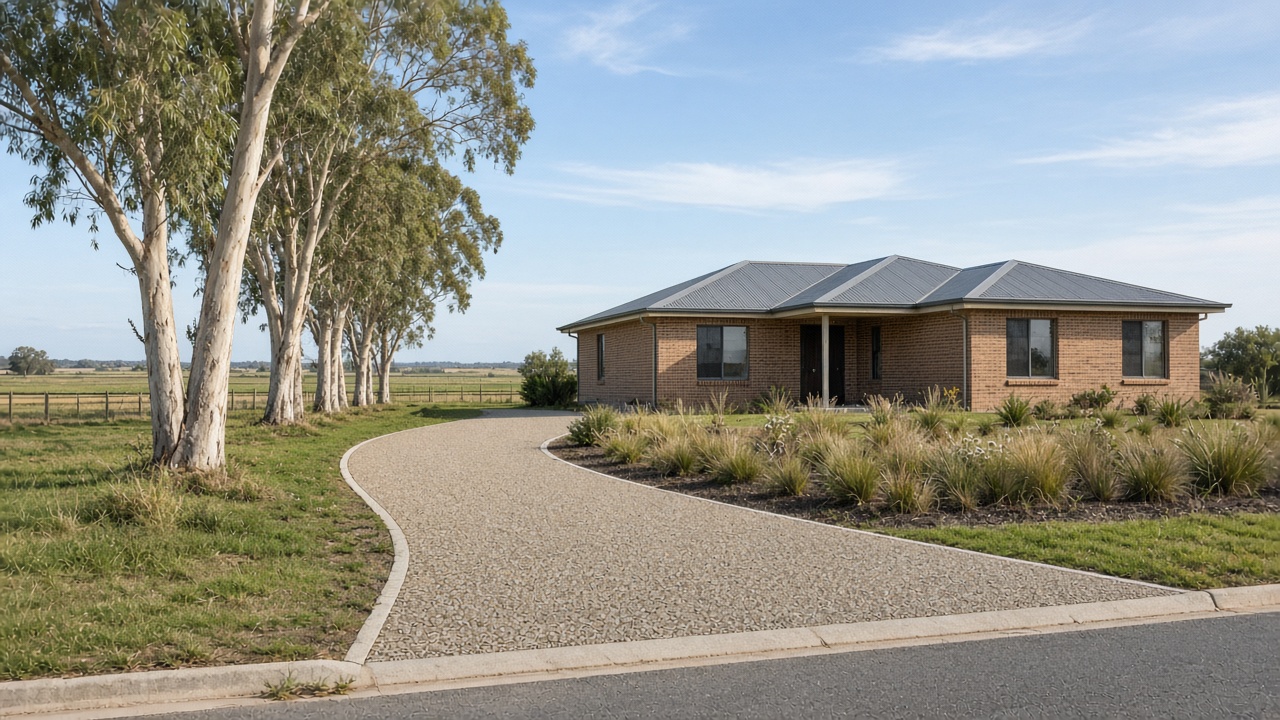
Concrete driveways in Koo Wee Rup
A driveway in Koo Wee Rup has to deal with flat ground, peat or clay under the surface, and the way water sits after rain. We design the falls, dig to a firm base, and finish it for the way you actually use the entrance.
Email: info@kooweerupconcreting.com.au
A driveway designed for this town, not a generic suburban pattern
Most driveways we are asked to look at in Koo Wee Rup have the same underlying story, even when the surface looks different. Water does not leave the block on its own. The ground under the grass is softer or heavier than the owner expected. The old crossover is higher or lower than it should be. And the entrance is used harder than a short city driveway — bins, utes, visitors, and on the rural edge, farm traffic.
We start by walking the line from the road to the garage or the house. We look at the kerb or table drain, the existing crossover, the fences and gates, and the spots that stay wet. Then we talk about excavation, base, thickness, reinforcement, joints and finish in ordinary language. You should leave that visit knowing why we want to dig as deep as we do, and what the driveway will do with rain once it is finished.
A new driveway is not only a new surface. It is a small piece of civil work on your property. If the base is thin, if the falls are guessed, or if the crossover is left as a lip, the new concrete will show those decisions within a couple of seasons. We would rather spend the first hour on those decisions than on a colour chart.
Peat, clay and why some driveways here need a deeper start
Koo Wee Rup was built on drained swamp country. In practical terms that means you cannot assume the first 150 millimetres of soil will carry a driveway. Peat can compress after a pour if it is left in place. Heavy clay can move with moisture. A driveway that was formed up on a shallow skim of crushed rock will follow that movement, especially along the edges and at the meeting point with a crossover.
On the quote visit we look for those conditions. Sometimes a probe or a look at a nearby garden bed is enough to see what we are dealing with. Sometimes the old driveway, once we break a corner, tells the story: a thin slab on wet soil, with no real base. Our quotes describe the excavation and base we believe the block needs. If we get into the job and the ground is worse than it looked, we stop and talk to you before we go deeper.
This is also why a published square-metre rate is a poor way to shop for a driveway in this town. Two houses in the same street can sit on different ground. One may need a standard suburban base. The other may need more excavation, more rock, and more careful compaction. We price the block in front of us.
Falls, joints and the details that keep a flat block dry
Because the township is so flat, falls have to be designed. We set levels so water moves away from the house and garage and toward the road or a drain, not into a low corner by a bedroom wall. On some blocks a spoon drain, a strip drain or a slight crowning of the driveway is the difference between a surface that dries and a surface that stays marked and slippery.
Control joints are planned, not added as an afterthought when a crack appears. Concrete will try to shrink as it cures. Joints give that movement a place to go. We mark them at spacings that suit the shape of your driveway, including at changes of width, at the garage opening, and where the driveway meets a path or a crossover.
Edges are another place that shows whether the job was careful. We form clean edges, compact beside them, and avoid leaving a thin, unsupported lip that breaks off under a wheel. Where the driveway meets lawn or garden, we talk about edging and soil levels so irrigation and mulch are not constantly washed onto the finish.
Township driveways, farm entrances and turning bays
In town the constraints are usually width, neighbours, and a crossover that has to meet the street neatly. We plan the pour so trucks and a pump — if one is needed — can work without damaging the nature strip more than necessary, and we keep access to the house where we can. A short driveway can still be a fussy job if the garage is tight, the fence is on the boundary, or the only fall is toward the door.
On acreage and market-garden properties the driveway is often longer, sometimes with a slight dogleg, a gate, a cattle grid, or a turning bay for a trailer. Thickness and reinforcement should match the vehicles that will use it, not a brochure average. We will ask what you drive and what visits the property, then quote a driveway that is meant to take that traffic. If only the first section from the road has failed, we can sometimes replace that length and meet the sound concrete further in, instead of tearing up a whole entrance.
Choosing a finish that will still look decent in ten years
Exposed aggregate is the finish many people in this area ask for first, and for good reason. The stone texture hides a bit of dirt, it is sure-footed in the wet, and it suits brick veneer and Colorbond houses without looking ornamental. Coloured concrete is a good choice when you want a quieter surface that still has some warmth. Plain broomed concrete is honest, serviceable, and often the right call for a side run, a farm gate or a budget that should go into the base rather than the show surface.
Stamped and stencil finishes can look very good on a front walk or a patio. We are slower to recommend them on a working driveway that will see implements, trailers or constant turning, because the pattern can wear and the surface can become harder to keep clean. We will tell you that on site, with samples in your actual light, rather than selling a look that does not match the use.
Whatever finish you choose, the preparation underneath stays the same conversation. A beautiful surface on a poor base is still a poor driveway.
Replacement, partial replacement and when to keep what you have
Not every cracked driveway needs to come out from the road to the garage. Hairline shrinkage cracks along a joint are not the same as a slab that has dropped, pumped mud at the edges, or broken into rocking panels. On the visit we will say whether we recommend a full replacement, a section replacement, or — where the slab is still structurally sound — a resurface or a repair.
If we recommend replacement, we will also talk about what happens to the crossover, any existing drains, and how we will keep you able to get a car off the street while the work is done. If we recommend keeping part of the driveway, we will explain how we will meet the new work to the old so you do not get a step or a weak joint at the join.
Koo Wee Rup soil, water and Cardinia Shire rules
Koo Wee Rup sits on land that was once a swamp, drained from the late nineteenth century so the township and the market gardens could exist. Under the grass you will often find peat, heavy clay, or a mix of the two, with a water table that can sit closer to the surface than it does in the hills. Peat can compress. Clay can shrink and swell with the seasons. A slab poured thin, straight onto that ground, will move with it.
We dig until we reach firm material, take out soft or wet soil, compact crushed rock in layers, set steel on chairs, and design falls so water leaves the house and the garage on this flat land. Winter rain can make compaction harder. A hot north wind can dry a finish too fast. We plan around both. Concrete inside your boundary rarely needs a council permit. Work in the road reserve — a crossover, a nature strip, a public footpath — can need Cardinia Shire's consent. A slab that will carry a building needs a building permit and, usually, engineering. Your quote spells out which of these apply.
How your Koo Wee Rup quote is put together
Every quote we send is written and itemised. It describes the area we measured, the excavation and where the spoil or old concrete will go, the compacted crushed-rock base, the slab thickness, the steel and how it will be supported, the finish, any sealer, and extras such as a drain, a step, a border or a new crossover. If Cardinia Shire or a building surveyor has to be involved, the quote names that rather than leaving it as a surprise.
The quote also describes the practical side of the pour: where a truck or pump would stand, how we protect gardens and fences, and how long the area needs to stay closed. If we think the ground may hide a problem — wet peat, an old slab, a pipe — we say so and explain how we would handle it. There are no prices on this website because two blocks in the same Koo Wee Rup street can need very different prep. The visit and the written quote cost you nothing.
What you get with Koo Wee Rup Concreting
Local to Koo Wee Rup 3981
We work the township first, then the hamlets and neighbouring Cardinia towns we actually drive to every week.
Built for peat, clay and flat ground
Deeper prep where the old swamp soil needs it, compacted bases, and falls that drain on land with almost no natural slope.
Free written quotes
Every job is itemised. No website rates, no pressure, and no charge to visit or to send the quote.
Shire-edge work handled clearly
Crossovers in the road reserve and any permit questions are named in the quote before we start.
Six steps to a finished job
- 1
Get in touch
Call, email, or send the form with a few photos of the area, the front of the property, and any tight gate.
- 2
Site visit
We measure, look at the ground, check levels and the crossover, and bring finish samples to hold against the house.
- 3
Written quote
You get an itemised quote covering digging, base, thickness, steel, finish, drainage and any shire or permit work.
- 4
Base and formwork
We remove failed concrete or topsoil, excavate soft material, compact the base, set the forms and place steel.
- 5
Pour and finish
Concrete is placed, levelled and finished, then protected while it cures in the week's weather.
- 6
Clean-up and care
We strip the forms, cut joints, take the rubble away, seal if it was quoted, and leave you care notes.
Concrete Driveways questions
How long before I can drive on a new driveway?
Walking on it is usually a matter of a day or two, depending on the weather. Driving on it needs longer. We will give you a clear window after the pour, and we will be conservative if the week is cold or very wet. Turning a vehicle too early is one of the easiest ways to mark a new surface.
Do I need a new crossover as well?
Not always. If the crossover is sound, at the right level, and can meet the new driveway cleanly, we will often recommend keeping it. If it is broken, too high, too low, or the wrong profile for the street, we will quote to replace it as part of the job.
Can you pour a driveway in winter in Koo Wee Rup?
Sometimes, if the ground can be compacted properly and the forecast will let the slab cure without being washed or frozen into a poor finish. If the peat is too wet or a storm is sitting over the district, we will wait. A delayed pour is better than a driveway that starts with a damaged surface.
Will you quote without a site visit?
We can talk in general terms from photos, but we will not give a firm written figure until we have seen the ground, the access and the crossover. In this town those three things change the job too much to price from a message alone.
Where we work
Other concreting services
Talk to a Koo Wee Rup concreter
We visit, measure and put it in writing for work in Koo Wee Rup 3981 and the Cardinia towns around it. Nothing on this site is priced, because no two blocks are the same.