Plain concrete in Koo Wee Rup
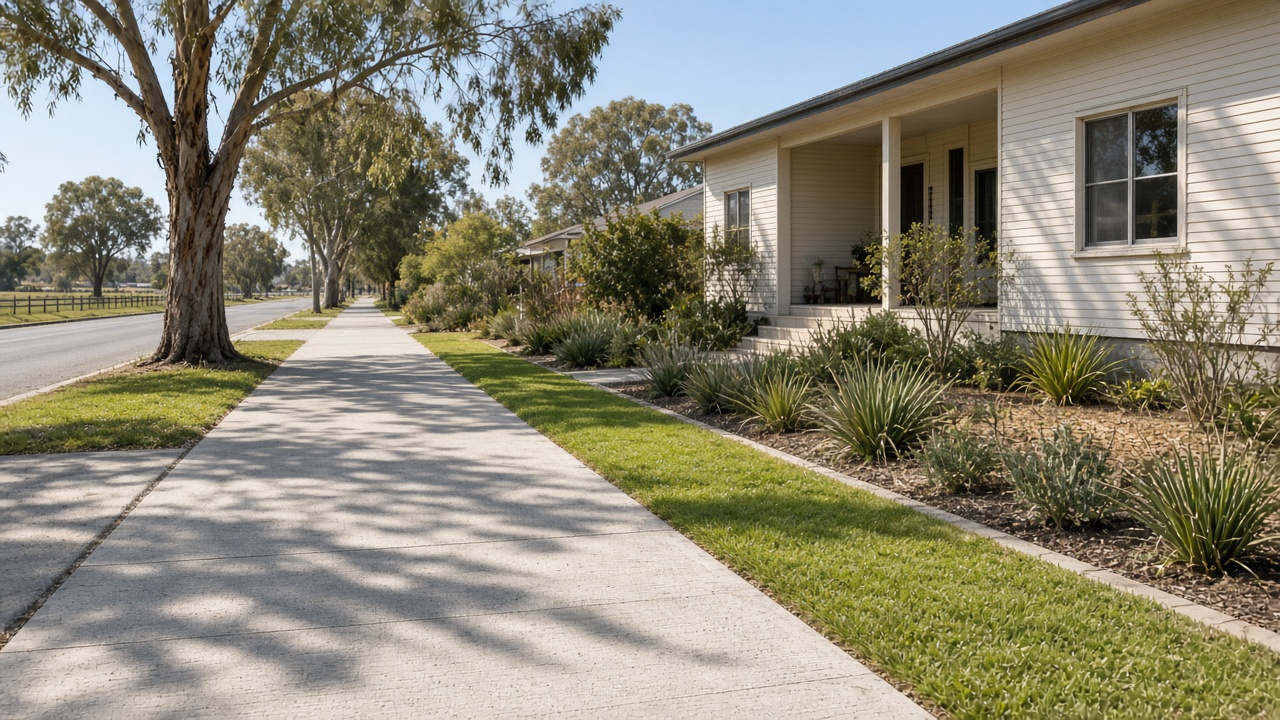
Plain broomed concrete is still the honest finish for many Koo Wee Rup jobs: sheds, side runs, farm gates and tidy township driveways where the money should go into the base.
Email: info@kooweerupconcreting.com.au
An honest finish that still has to be built properly
Plain concrete does not mean careless concrete. A broomed grey slab, neatly edged and jointly correctly, is one of the most useful surfaces we pour in this town. It is the right choice when a driveway or hardstand will be used hard, when a shed needs a tough floor, or when you would rather put the budget into excavation and base than into a decorative face.
The work underneath is the same as any other pour in Koo Wee Rup. We still dig to a firm level, compact a crushed-rock base, set falls on this flat ground, and place steel so the slab can span minor movement. A cheap, thin plain slab on peat is still a cheap, thin slab on peat. The absence of colour or stone is not a reason to skip prep.
Broomed texture, edges and where plain work shines
We usually finish plain concrete with a broom so the surface has grip in the wet. A steel-trowel finish can look sleek and then become slippery once it has a film of winter mud. On shed floors we will talk about the balance between a tighter finish for sweeping and enough texture for safe footing. On driveways and paths, a consistent broom is almost always the sensible call.
Clean edges and planned joints are what make a plain slab look considered rather than unfinished. We form straight lines, meet doorways and crossovers neatly, and cut joints at the spacings the shape needs. A tidy grey driveway on a township street can look very handsome next to brick and a simple garden, without asking to be the main feature of the house.
Farm gates, bin pads and working surfaces
A lot of our plain work sits behind the front boundary: side runs to a clothesline, bin pads, turning bays, shed aprons, and the second half of a long rural entrance. These areas still need falls that work, especially where a tank overflow or a wash-down area can send water across the slab. We will ask how you use the space and set the surface accordingly, including any thickenings at gate posts or where a trailer jack sits.
If you want a decorative finish at the street and a plain slab further in, we can design that split so the join is neat and the drainage is one system. That is often a good way to spend money on a large property.
Why a plain slab is often the right spend in this district
In Koo Wee Rup, the part of a job you do not see is usually the part that fails. A farm entrance that looks 'only grey' can still have a deep excavation, a thick compacted base, properly supported steel and falls that work after a night of rain. That is a better spend than a thin decorative driveway that looks handsome for a season and then drops at the gate.
We say this plainly because people sometimes apologise for asking for plain concrete, as if they were asking for a lesser job. They are not. They are asking for a durable surface. We will still form it neatly, still broom it evenly, still cut the joints on a plan, and still meet the house, the shed or the crossover with care. The difference is that the money has gone into the ground, which is where this town demands it.
Texture, safety and the look of a simple driveway
A consistent broom, run the same way and at the same pressure, is what makes a plain driveway look finished. A patchy broom looks careless even if the slab is structurally fine. On a path or a north-facing patio we keep the texture enough for wet feet. On a shed floor we may tighten the finish in the middle for sweeping, and keep more texture at the door. Those are ordinary finishing decisions, and we will talk about them before pour day rather than inventing them with the truck waiting.
Plain concrete also makes a good neighbour to a more decorative front section. Many properties here want a presentable entrance and a tough working length. A clean joint, a slight change of broom, or a small change of level can mark that change without a fussy border. We will only design it that way if both parts still drain as one system.
Where plain work quietly does the heavy lifting
Bin pads, side runs, clothesline paths, pump pads, drying yards and the apron around a tank are the unglamorous jobs that make a property easier to live on. They still pond if the falls are wrong. They still crack if they are poured thin on peat. We quote them with the same respect we give a front driveway, and we will often suggest doing two or three of those smaller pads in the same visit if they share access, because the mobilisation is then used well.
Living with a plain driveway through a Gippsland year
A broom-finished driveway in this town has a quiet job to do in every season. In winter it should shed water and stay sure-footed when you come in after dark. In a dry stretch it should not throw dust like a worn gravel track. In a hot January it should be a surface you can walk on to a bin or a car without feeling as if it were polished glass. Those are ordinary tests, and a consistent texture, sensible joints and a proper base are what pass them.
We will also talk about edges. A plain slab with a broken, thin edge looks neglected even when the field is sound. We like a supported edge, a clean meeting with a garden or a crossing, and a joint that is meant to be there. If you later add a path or a bin pad, we can leave a detail that makes that addition tidy rather than a bolted-on strip. Plain work is not 'less design'. It is design with fewer decorations and no less care.
Koo Wee Rup soil, water and Cardinia Shire rules
Koo Wee Rup sits on land that was once a swamp, drained from the late nineteenth century so the township and the market gardens could exist. Under the grass you will often find peat, heavy clay, or a mix of the two, with a water table that can sit closer to the surface than it does in the hills. Peat can compress. Clay can shrink and swell with the seasons. A slab poured thin, straight onto that ground, will move with it.
We dig until we reach firm material, take out soft or wet soil, compact crushed rock in layers, set steel on chairs, and design falls so water leaves the house and the garage on this flat land. Winter rain can make compaction harder. A hot north wind can dry a finish too fast. We plan around both. Concrete inside your boundary rarely needs a council permit. Work in the road reserve — a crossover, a nature strip, a public footpath — can need Cardinia Shire's consent. A slab that will carry a building needs a building permit and, usually, engineering. Your quote spells out which of these apply.
How your Koo Wee Rup quote is put together
Every quote we send is written and itemised. It describes the area we measured, the excavation and where the spoil or old concrete will go, the compacted crushed-rock base, the slab thickness, the steel and how it will be supported, the finish, any sealer, and extras such as a drain, a step, a border or a new crossover. If Cardinia Shire or a building surveyor has to be involved, the quote names that rather than leaving it as a surprise.
The quote also describes the practical side of the pour: where a truck or pump would stand, how we protect gardens and fences, and how long the area needs to stay closed. If we think the ground may hide a problem — wet peat, an old slab, a pipe — we say so and explain how we would handle it. There are no prices on this website because two blocks in the same Koo Wee Rup street can need very different prep. The visit and the written quote cost you nothing.
What you get with Koo Wee Rup Concreting
Local to Koo Wee Rup 3981
We work the township first, then the hamlets and neighbouring Cardinia towns we actually drive to every week.
Built for peat, clay and flat ground
Deeper prep where the old swamp soil needs it, compacted bases, and falls that drain on land with almost no natural slope.
Free written quotes
Every job is itemised. No website rates, no pressure, and no charge to visit or to send the quote.
Shire-edge work handled clearly
Crossovers in the road reserve and any permit questions are named in the quote before we start.
Six steps to a finished job
- 1
Get in touch
Call, email, or send the form with a few photos of the area, the front of the property, and any tight gate.
- 2
Site visit
We measure, look at the ground, check levels and the crossover, and bring finish samples to hold against the house.
- 3
Written quote
You get an itemised quote covering digging, base, thickness, steel, finish, drainage and any shire or permit work.
- 4
Base and formwork
We remove failed concrete or topsoil, excavate soft material, compact the base, set the forms and place steel.
- 5
Pour and finish
Concrete is placed, levelled and finished, then protected while it cures in the week's weather.
- 6
Clean-up and care
We strip the forms, cut joints, take the rubble away, seal if it was quoted, and leave you care notes.
Plain Concrete questions
Does plain concrete look unfinished?
Not if the edges, joints and broom are even. A well-made grey slab is a standard, durable finish, not a half-done job. If you later want more colour, we can talk about that at the quote, not as a regret.
Can plain concrete be coloured later?
A coating or a resurface can change the look of a sound slab. It will not fix a slab that has dropped or cracked badly. We would rather help you choose the right finish now than rely on a later cover.
Where we work
Other concreting services
Talk to a Koo Wee Rup concreter
We visit, measure and put it in writing for work in Koo Wee Rup 3981 and the Cardinia towns around it. Nothing on this site is priced, because no two blocks are the same.