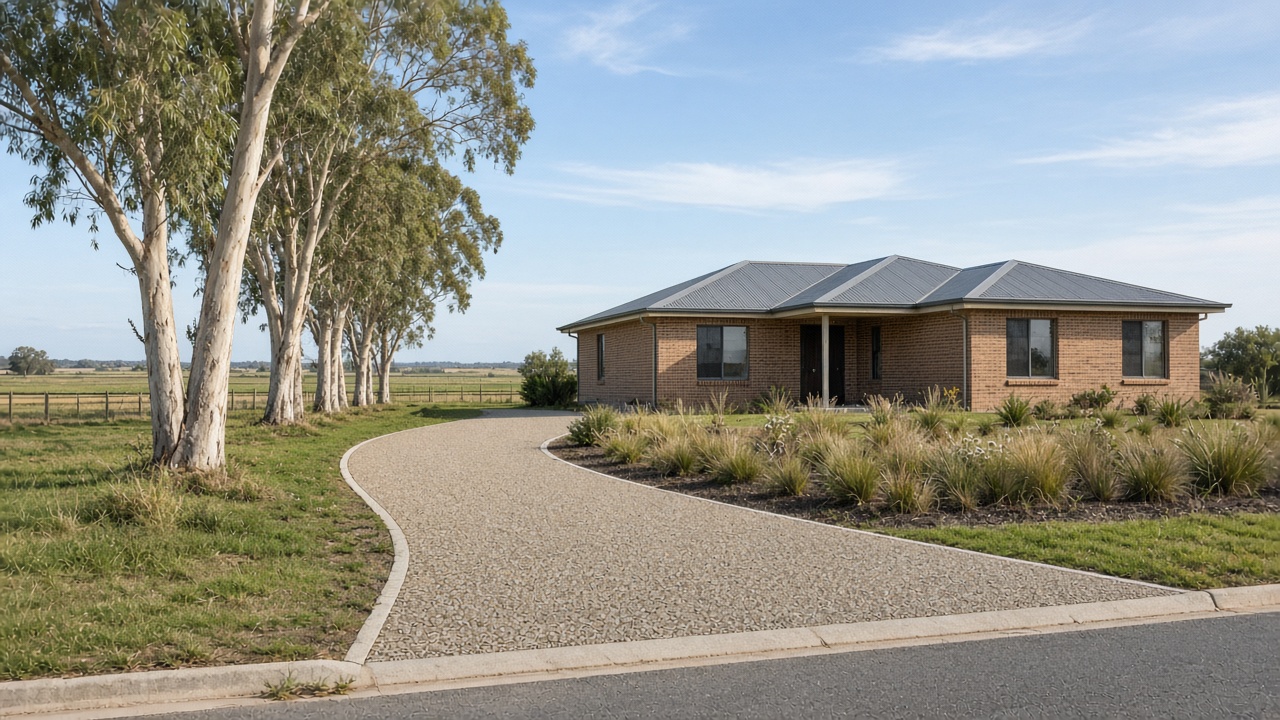
A practical guide to driveways on Koo Wee Rup clay and peat
Koo Wee Rup sits on old swamp country. The ground under a driveway here is often the real job. This guide explains, in plain language, what clay and peat do to a slab, what we look for on a visit, and how a careful driveway is prepared so it can last on this flat land.
Email: info@kooweerupconcreting.com.au
Why this town is different underfoot
Many Victorian towns have clay. Koo Wee Rup also has a history as drained swamp, with peat and soft pockets in places that look perfectly ordinary from the street. A front lawn can feel firm on a dry afternoon and still hide a wet corner, a filled drain line, or a patch of dark, spongy ground a little below the grass. That is why a driveway quote in this town should start with the ground, not with a colour chart.
Peat and soft organic ground compress under a load. Clay changes with moisture: it can be tight when dry and sticky, slow and weak when wet. A slab that is poured thin, or poured on a base that was never properly compacted, will show that movement later as a dip at the gate, a crack that opens after a wet week, or a joint that becomes a step. Those failures are common enough in this district that we would rather talk about them before the work starts than explain them afterwards.
This is not a reason to avoid concrete. It is a reason to do the unglamorous work: excavation to a sensible depth, a compacted crushed-rock base, steel as specified, falls that actually move water, and a refusal to pour on a pumping, wet pad just to keep a date. The towns around us — Bayles, Cora Lynn, Cardinia, Tooradin, Lang Lang and the rest of our usual run — ask variations of the same question. The lowest, flattest Koo Wee Rup blocks often ask it most clearly.
What we look at on a first visit
A visit is not a sales walk. We want to see how the block sits, where water already goes after rain, how a vehicle turns in, and what the existing crossing or gravel entrance is doing. We look at the garage floor or the house door level, because a new driveway has to meet those heights without sending water toward the building. We look at trees, tanks, irrigation and any obvious fill. We also look at how a truck or a pump will reach the pour without chewing a lawn or blocking a neighbour.
You do not need to be a soil expert to help. If you know the yard gets soft in one corner, if an old driveway already dipped, or if the block was filled when the house was built, say so. Those observations are often as useful as a first glance at the surface. If the job is a house or granny-flat slab, the soil report and the engineering are the documents that govern the pour. We read them. We do not casually vary them to make a day easier.
On a rural entrance we also walk the roadside drain, the culvert, and the first metres inside the gate. A handsome private slab that then sits too low at a pipe crossing, or that dams a table drain, is a poor neighbour and a poor design. The public edge and the private drive have to be thought of as one system, even when only one of them is being poured this time.
Excavation, base and the temptation to pour thin
The part of a Koo Wee Rup driveway you do not see is usually the part that decides its life. We excavate to remove soft or unsuitable material and to make room for a compacted base. How far we go depends on what we find. A short, firm township frontage and a long rural entrance that has been built up with mixed fill are not the same job, even if the visible slab area looks similar on a plan.
A crushed-rock base, placed and compacted in layers, gives the slab something to sit on. Skipping that work, or placing a thin slab straight onto a 'looks all right' pad, is how early movement begins. People sometimes ask whether a little extra thickness in the concrete can make up for a poor base. Thickness helps a slab span and carry a load, but it is not a substitute for ground that has been prepared. On peat or soft fill, the honest conversation may be about more excavation, a deeper base, or, in some cases, a design that needs advice beyond an ordinary residential driveway. We will say that if we see it, rather than guess and hope.
Steel, joint layout and edge support belong in the same conversation. A driveway that turns a car at the garage, or that takes a trailer at a farm gate, has stress concentrations. We plan joints so they control cracking rather than decorate a failure after it has happened. Edges that are left thin or poorly supported are often the first places to break away.
Falls, flat land and where the water goes
Koo Wee Rup is famously flat. That is part of its character, and it is a drainage problem. There is often no convenient hillside to throw water down. A driveway still has to shed rain, irrigation and the odd summer storm, and it has to do that without wetting a garage door, a house wall, or a neighbour's fence line.
On the visit we look at existing levels and we will tell you if a design needs a slight lift, a spoon drain, a carefully set meeting at the crossing, or a change at the door. A slab that is almost level because 'the yard is flat anyway' will pond. Those ponds become stains, then slip hazards, then the place winter water sits and works at a joint.
We also think about the week after a downpour, not only the afternoon of the pour. This district can hold water on the land. A base that was compacted on a dry day can still be at risk if a job is opened and then left in a wet week. We would rather reschedule a pour than put concrete down on a pumping pad. That can be frustrating when you have cleared the calendar. It is still the right call, and we will explain it plainly if the weather turns.
Old driveways, fill and the decision to replace
Many jobs in this town start with a failed or tired surface: a cracked front drive, a dipped crossing, a path that now trips at the door. The first question is not 'what colour shall we put over it?' The first question is whether the slab and the ground underneath are still a sensible base.
If a driveway has already settled, if cracks have become steps, or if water sits at the garage, a resurface will usually copy the problem in a fresher finish. Removal and replacement, with a proper look at the ground once the old work is gone, is often the honest job. We would rather say that on the visit than sell a thin new skin and be asked later why it followed the old dips.
Fill is a particular caution. A block that was built up when the house went on, a former drain, or a low corner that was 'made up' with whatever was handy can look level and still be a poor foundation. Once the old slab is out, we can see more. If the ground is worse than it looked, we will talk about it before we form the new work, even if that changes the plan. A surprise in the ground is not an excuse to quietly pour thinner.
Finishes that live with this climate and this ground
Once the groundwork is right, the finish is a choice about use, light and care. Exposed aggregate is popular on township frontages because it hides a little dust, has good wet grip, and sits well with brick and Colorbond. A well-made broom finish is often the right answer on a working length, a shed approach, or a farm entrance that will see mud and implements. Colour can look handsome if the tone is chosen on the ground, in this bright, open light, and if you accept that a colour makes joints and marks more visible.
We are slower to recommend a busy stamped pattern on the only driveway of a working property, because the highs wear and the lows hold dirt. A patio or a contained courtyard is a kinder setting for a pattern. None of those finish choices will rescue a slab that was poured on a poor base. The best exposed aggregate in the district will still crack and dip if the peat under it was never dealt with.
Aftercare is simple and important. Keep traffic off until we say the slab is ready. Keep skips and steel stacks off a young surface. Clean gently. If a sealer is part of the job, let it go on at the right time and do not treat it as a magic film that removes the need for care. The climate here is wet enough, and the light is hard enough, that small disciplines in the first weeks are worth more than a product promise.
A short checklist before you accept any driveway quote
Ask what the quote assumes about excavation and the base, not only about the square metres of finished surface. Ask how falls will be set on a flat block, and how the new work will meet the garage, the house and the crossing. Ask what happens if the ground is worse than it looks once an old slab is out. Ask when you can walk on the work and when you can drive on it. And ask whether the public crossing is included, excluded, or still waiting on a shire process.
You should also be wary of a price given from photos alone, or of a start date that cannot move if the week is wet. In Koo Wee Rup those shortcuts show up later, in the ground, where they are expensive to undo. A careful crew will visit, will talk about peat and clay without theatre, and will rather hold a pour than pretend the weather or the soil does not matter.
If you want us to walk your block with that list in mind, call 0407 977 529 or send a few photos and the suburb through the form. The visit is free, the quote is written, and we will tell you what we see, including if the honest job is smaller, larger, or different from what you first had in mind.
Talk to a Koo Wee Rup concreter
We visit, measure and put it in writing for work in Koo Wee Rup 3981 and the Cardinia towns around it. Nothing on this site is priced, because no two blocks are the same.