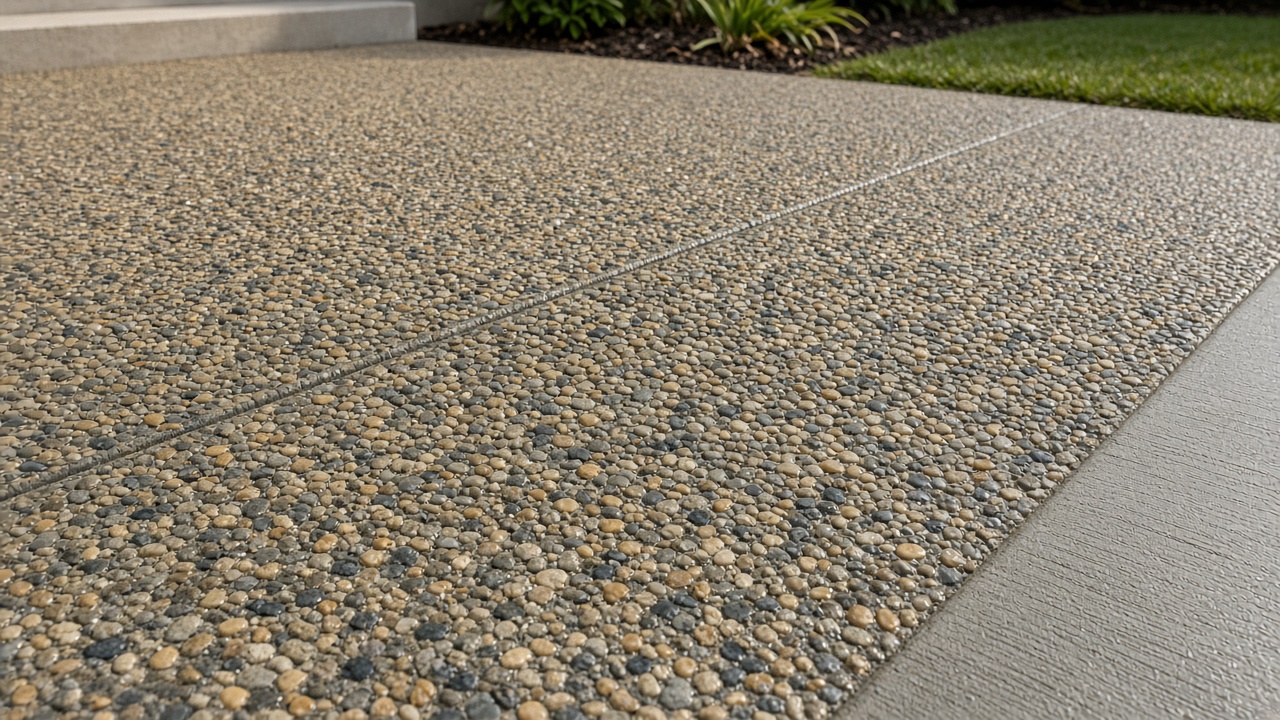
Exposed aggregate in Koo Wee Rup
Exposed aggregate is the finish many Koo Wee Rup homes ask for first: a sure-footed, stone-textured surface that copes with wet weather and everyday dirt when the base and the wash are done properly.
Email: info@kooweerupconcreting.com.au
Why exposed aggregate suits this town
Koo Wee Rup is flat, often damp underfoot after rain, and used harder than a quiet inner-suburban street. Exposed aggregate — a concrete slab with the surface paste washed back so the stone shows — handles that use well. The texture gives grip when the ground is wet. The stone mix hides a bit of mud, irrigation overspray and the dusty marks that a perfectly smooth slab shows immediately. Against a brick veneer wall, a Colorbond roof and a row of gums, a well-chosen blend also looks like it belongs here rather than like a showroom floor.
We still treat it as a structural driveway or patio first. The excavation, base, steel, falls and joints are the same conversation we have on any pour in this town. The wash and the stone blend are the last part, not a way to skip the work underneath. An exposed finish on a poorly prepared base will still drop, pond or crack. The difference is that you will have paid for a nicer surface on a problem that was predictable.
Stone blends, borders and edges
There is no single 'Koo Wee Rup mix', and we will not pretend there is. Blends run from warmer honey and river pebble through greys and charcoals. Some people want a contrasting plain or coloured border; some want a clean sawcut edge and nothing else. We bring samples to the property and look at them in your actual light, next to the brick, the roof and the garden, because a blend that looks soft on a screen can read much colder or much busier once it is down.
Borders need to be designed into the formwork, not added as an afterthought. A plain band along the edge can frame the stone and give a neater meeting with a lawn or a crossover. It also gives us a place to run a slightly different fall or a drain detail if the block needs it. We will tell you if a busy border is going to fight a short driveway, or if a simple mix will look better on a long rural entrance.
The wash itself is a skilled step. Wash too early or too hard and you can loosen stone or leave a patchy depth. Wash too late and the paste will not come off evenly. We time that work to the mix and the weather, then we clean the surface properly so you are not left with a cement haze.
Grip, cleaning and the honest downsides
People search for the downsides of exposed aggregate, and they are real. The textured surface can collect more dirt in the lows between stones than a steel-trowelled slab. Leaves, mud and grass clippings need an occasional hose or a light pressure clean. If you want a surface you can mop like an indoor floor, this is not the finish. If you want something that still looks decent after a wet Gippsland week and a few trips to the gate, it is often the right one.
Smoothing an exposed surface after the fact is not a simple polish. The stone is meant to be proud of the paste. If you have seen a very smooth, honed aggregate, that is a different process and a different look, and we will talk about it as a separate choice rather than as a repair for a wash you later decide you dislike.
Sealing is often worthwhile, especially on a front driveway, because it helps with staining and makes cleaning easier. It is not magic, and it needs to be renewed over time. We will say whether a sealer is in the quote and when it should go on after the pour. We will not tell you that a sealer removes the need for any care.
Where we use it — driveways, paths and patios
Most of the exposed aggregate we pour here is on driveways, including replacements of tired plain slabs and new entrances on township and rural blocks. It also works well on front paths, side gates and some patios, particularly where the area will be walked on in the wet. Around a pool, the grip is useful, but we will also talk about heat, salt and how the surrounding paving or coping should meet the slab.
On farm entrances we sometimes recommend exposed aggregate only on the first, more public section, with a plain broomed slab further in where implements and mud are harder on a show finish. That kind of split can be a sensible way to spend the budget. We will only suggest it if the join can be made neatly and the falls still work as one system.
Prep on peat and clay still comes first
None of the finish conversation changes the ground in Koo Wee Rup. If we are pouring exposed aggregate over peat or wet clay without a proper excavation and compacted base, the prettiest stone mix in the district will still follow the movement underneath. Our quotes for this finish always include the same honest prep we describe on the main driveway page. If the visit shows we need to go deeper, that is part of the job, not an optional upgrade.
Typical exposed aggregate specification
| Base | Compacted crushed rock, deepened over peat, soft spots or wet clay rather than a single shallow default |
|---|---|
| Slab depth | Sized for the vehicles and the ground we see — not a single brochure thickness for every street |
| Steel | Mesh on bar chairs, with extra bars where corners and openings need them |
| Joints | Planned saw cuts and isolation joints at the house, garage and existing slabs |
| Falls | Designed on this flat land so water leaves the house, the garage and the crossover |
| Sealer | Where it is in the quote, applied at the right time after curing, with a product that still has grip |
Koo Wee Rup soil, water and Cardinia Shire rules
Koo Wee Rup sits on land that was once a swamp, drained from the late nineteenth century so the township and the market gardens could exist. Under the grass you will often find peat, heavy clay, or a mix of the two, with a water table that can sit closer to the surface than it does in the hills. Peat can compress. Clay can shrink and swell with the seasons. A slab poured thin, straight onto that ground, will move with it.
We dig until we reach firm material, take out soft or wet soil, compact crushed rock in layers, set steel on chairs, and design falls so water leaves the house and the garage on this flat land. Winter rain can make compaction harder. A hot north wind can dry a finish too fast. We plan around both. Concrete inside your boundary rarely needs a council permit. Work in the road reserve — a crossover, a nature strip, a public footpath — can need Cardinia Shire's consent. A slab that will carry a building needs a building permit and, usually, engineering. Your quote spells out which of these apply.
How your Koo Wee Rup quote is put together
Every quote we send is written and itemised. It describes the area we measured, the excavation and where the spoil or old concrete will go, the compacted crushed-rock base, the slab thickness, the steel and how it will be supported, the finish, any sealer, and extras such as a drain, a step, a border or a new crossover. If Cardinia Shire or a building surveyor has to be involved, the quote names that rather than leaving it as a surprise.
The quote also describes the practical side of the pour: where a truck or pump would stand, how we protect gardens and fences, and how long the area needs to stay closed. If we think the ground may hide a problem — wet peat, an old slab, a pipe — we say so and explain how we would handle it. There are no prices on this website because two blocks in the same Koo Wee Rup street can need very different prep. The visit and the written quote cost you nothing.
What you get with Koo Wee Rup Concreting
Local to Koo Wee Rup 3981
We work the township first, then the hamlets and neighbouring Cardinia towns we actually drive to every week.
Built for peat, clay and flat ground
Deeper prep where the old swamp soil needs it, compacted bases, and falls that drain on land with almost no natural slope.
Free written quotes
Every job is itemised. No website rates, no pressure, and no charge to visit or to send the quote.
Shire-edge work handled clearly
Crossovers in the road reserve and any permit questions are named in the quote before we start.
Six steps to a finished job
- 1
Get in touch
Call, email, or send the form with a few photos of the area, the front of the property, and any tight gate.
- 2
Site visit
We measure, look at the ground, check levels and the crossover, and bring finish samples to hold against the house.
- 3
Written quote
You get an itemised quote covering digging, base, thickness, steel, finish, drainage and any shire or permit work.
- 4
Base and formwork
We remove failed concrete or topsoil, excavate soft material, compact the base, set the forms and place steel.
- 5
Pour and finish
Concrete is placed, levelled and finished, then protected while it cures in the week's weather.
- 6
Clean-up and care
We strip the forms, cut joints, take the rubble away, seal if it was quoted, and leave you care notes.
Exposed Aggregate questions
How often should you seal an exposed aggregate driveway?
It depends on the sealer, the weather and how the driveway is used. We will recommend a first seal at the right time after curing, then a simple inspection later rather than a fixed calendar. If water no longer beads, or if stains start to sit in the surface, it is time to talk about a clean and a new coat.
What are the downsides of exposed aggregate?
It can hold a little more dirt than a smooth slab, the wash has to be done well or the surface looks patchy, and it is not the cheapest finish because of the stone and the extra labour. It also is not the right choice if you want a perfectly smooth, mop-able floor. Those are the honest trade-offs. The grip and the way it hides everyday marks are the reasons people still choose it here.
Can I have exposed aggregate if my old driveway is cracked?
If the old slab is sound, a resurfacing system can sometimes give you a new textured look. If the slab has dropped, rocked or failed at the edges, we will recommend a new pour on a proper base instead of putting a new face on a moving slab. The visit is where we decide which path is honest.
How do you make the surface even?
The slab is screeded and levelled like any other pour, with falls built in. The exposed look comes from washing the surface paste, not from leaving the slab uneven. If you have seen a lumpy exposed driveway, that is a finishing problem, not a feature of the method.
Where we work
Other concreting services
Talk to a Koo Wee Rup concreter
We visit, measure and put it in writing for work in Koo Wee Rup 3981 and the Cardinia towns around it. Nothing on this site is priced, because no two blocks are the same.