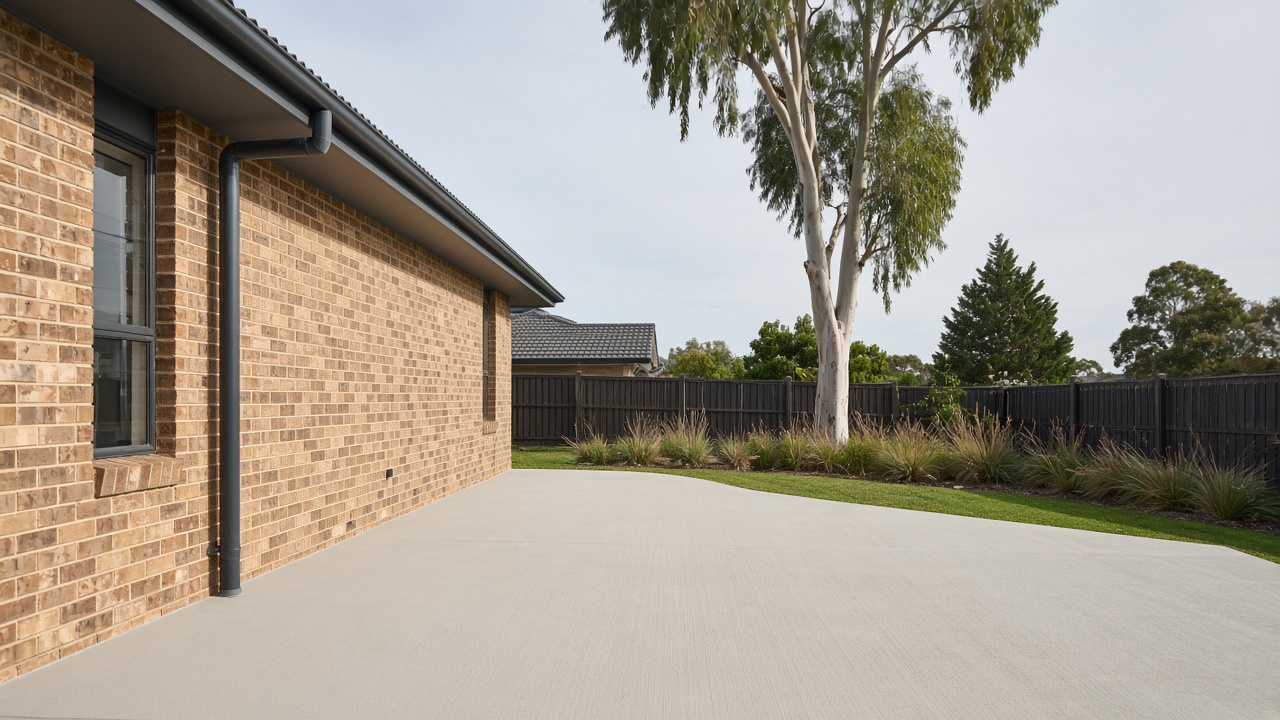
Stamped and stencil concrete in Koo Wee Rup
Stamped and stencil concrete can give a Koo Wee Rup patio or front path a patterned look, as long as the pattern is chosen for light use and the slab underneath is built for the ground.
Email: info@kooweerupconcreting.com.au
Patterned finishes that should be used in the right places
Stamped concrete is a coloured or grey slab with a pattern pressed into the surface while it is still plastic. Stencil work can give a similar decorative effect with a different method. Both can look very good on a patio, an alfresco floor or a front path. We are more careful about recommending them on a working driveway, especially one that will see trailers, turning utes or farm traffic, because patterns wear at the high points and can become harder to keep clean.
If you have fallen in love with a slate or timber pattern, we will look at where it will live on the property and tell you honestly whether it is a good fit. A quiet courtyard on the north side of the house is a different job from the only entrance to a shed.
Colour, pattern and the Victorian light
Patterns read differently in bright, flat Gippsland light than they do in a shaded display yard. Busy patterns can look noisy against a simple brick veneer. Softer, larger patterns usually sit more comfortably. We will show you samples on site and talk about border details, sawcuts and how the pattern should meet a house wall, a step or a garden edge.
The slab still needs proper falls. A patterned surface does not hide a pond. In some patterns, a low spot is even more obvious because the texture changes the way water sits. We set levels first, then we stamp or stencil to those levels.
Care, sealing and expectations
Patterned concrete usually needs a sealer to protect the colour and to make cleaning easier. The sealer will need to be renewed. Harsh pressure cleaning can wear the high points of a stamp. We will give you simple care notes, and we will not describe the finish as maintenance-free.
If a patterned look is important but the area is a hard-working driveway, we may suggest exposed aggregate or coloured concrete instead, or a patterned path leading to a plainer entrance. The visit is the right time for that conversation, before the forms go in.
Where a pattern earns its place in Koo Wee Rup
A stamped or stencil patio can give a courtyard a finished look that a plain broom sometimes does not, especially where the area is contained by fences, a house wall and a garden, and where the use is walking, dining and sitting rather than turning a trailer. That is the setting we like for this finish. A short front path can also take a quieter pattern if the rest of the entrance is calmer.
We are slower to recommend a busy stamp on the only driveway of a working property. The high points of the pattern wear under turning wheels. Mud and grass sit in the lows. A sealer helps, but it does not remove the need for care. If you love the look and the driveway is a light-use township entrance, we can still talk about it, with samples on the ground and a clear conversation about cleaning. If the entrance is a farm gate, we will usually steer you toward exposed aggregate or a good broom, and keep the pattern for the patio.
Designing the pattern so it does not fight the house
Simple brick veneer houses, pale roofs and open flat gardens are common here. A small, busy pattern can make a modest courtyard feel crowded. A larger, softer pattern, or a stencil that is more texture than picture, usually sits more comfortably. Borders should be straight and deliberate. Meetings at steps and doorways should be planned so you do not get a sliver of pattern cut off awkwardly.
We also think about glare. Some coloured stamps go very dark, and on an unshaded north or west patio they can become hot and visually heavy. We will talk about colour as well as pattern, in the actual light of the yard, not only from a catalogue.
The slab underneath is still a Koo Wee Rup slab
Nothing about a pattern changes the peat or the clay. We still excavate, still compact a base, still set falls away from the house, and still cut joints. If a patterned patio ponds at a sliding door, the pattern will not forgive it. If you already have a failed stamped surface, we will look at whether the slab underneath is worth keeping or whether the honest job is to take it out and start again. A second stamp on a moving base is a short-lived disappointment.
Samples, borders and a honest conversation about upkeep
If a pattern is still the finish you want after we have walked the site, we will do it with samples on the ground and a clear plan for borders and joints. A border that is straight and a little calmer than the field usually helps a modest courtyard. A pattern that runs hard into a step or a door without a plan looks unfinished, and it is harder to make good later.
Upkeep should be in the quote conversation, not in a surprise a year on. You will need to sweep, wash with ordinary care, and think about a sealer as a maintenance choice rather than a one-time shine. If that does not fit the way the yard is used — dogs, farm boots, a constant turn of a trailer — we will say so and show you a better finish for that use. We would rather keep a patterned patio as a patio, and keep the driveway as a driveway, than force one idea onto every surface.
Koo Wee Rup soil, water and Cardinia Shire rules
Koo Wee Rup sits on land that was once a swamp, drained from the late nineteenth century so the township and the market gardens could exist. Under the grass you will often find peat, heavy clay, or a mix of the two, with a water table that can sit closer to the surface than it does in the hills. Peat can compress. Clay can shrink and swell with the seasons. A slab poured thin, straight onto that ground, will move with it.
We dig until we reach firm material, take out soft or wet soil, compact crushed rock in layers, set steel on chairs, and design falls so water leaves the house and the garage on this flat land. Winter rain can make compaction harder. A hot north wind can dry a finish too fast. We plan around both. Concrete inside your boundary rarely needs a council permit. Work in the road reserve — a crossover, a nature strip, a public footpath — can need Cardinia Shire's consent. A slab that will carry a building needs a building permit and, usually, engineering. Your quote spells out which of these apply.
How your Koo Wee Rup quote is put together
Every quote we send is written and itemised. It describes the area we measured, the excavation and where the spoil or old concrete will go, the compacted crushed-rock base, the slab thickness, the steel and how it will be supported, the finish, any sealer, and extras such as a drain, a step, a border or a new crossover. If Cardinia Shire or a building surveyor has to be involved, the quote names that rather than leaving it as a surprise.
The quote also describes the practical side of the pour: where a truck or pump would stand, how we protect gardens and fences, and how long the area needs to stay closed. If we think the ground may hide a problem — wet peat, an old slab, a pipe — we say so and explain how we would handle it. There are no prices on this website because two blocks in the same Koo Wee Rup street can need very different prep. The visit and the written quote cost you nothing.
What you get with Koo Wee Rup Concreting
Local to Koo Wee Rup 3981
We work the township first, then the hamlets and neighbouring Cardinia towns we actually drive to every week.
Built for peat, clay and flat ground
Deeper prep where the old swamp soil needs it, compacted bases, and falls that drain on land with almost no natural slope.
Free written quotes
Every job is itemised. No website rates, no pressure, and no charge to visit or to send the quote.
Shire-edge work handled clearly
Crossovers in the road reserve and any permit questions are named in the quote before we start.
Six steps to a finished job
- 1
Get in touch
Call, email, or send the form with a few photos of the area, the front of the property, and any tight gate.
- 2
Site visit
We measure, look at the ground, check levels and the crossover, and bring finish samples to hold against the house.
- 3
Written quote
You get an itemised quote covering digging, base, thickness, steel, finish, drainage and any shire or permit work.
- 4
Base and formwork
We remove failed concrete or topsoil, excavate soft material, compact the base, set the forms and place steel.
- 5
Pour and finish
Concrete is placed, levelled and finished, then protected while it cures in the week's weather.
- 6
Clean-up and care
We strip the forms, cut joints, take the rubble away, seal if it was quoted, and leave you care notes.
Stamped Concrete questions
Will stamped concrete crack along the pattern?
Concrete can crack for the same reasons any slab can — movement, a thin base, or missing joints. The pattern does not replace proper joints and prep. We still design those as we would for a plain slab.
Is stamped concrete slippery?
Some patterns and sealers can be. We choose texture and, where needed, a sealer type that still has grip, especially on a path or patio that will be walked on after rain.
Where we work
Other concreting services
Talk to a Koo Wee Rup concreter
We visit, measure and put it in writing for work in Koo Wee Rup 3981 and the Cardinia towns around it. Nothing on this site is priced, because no two blocks are the same.