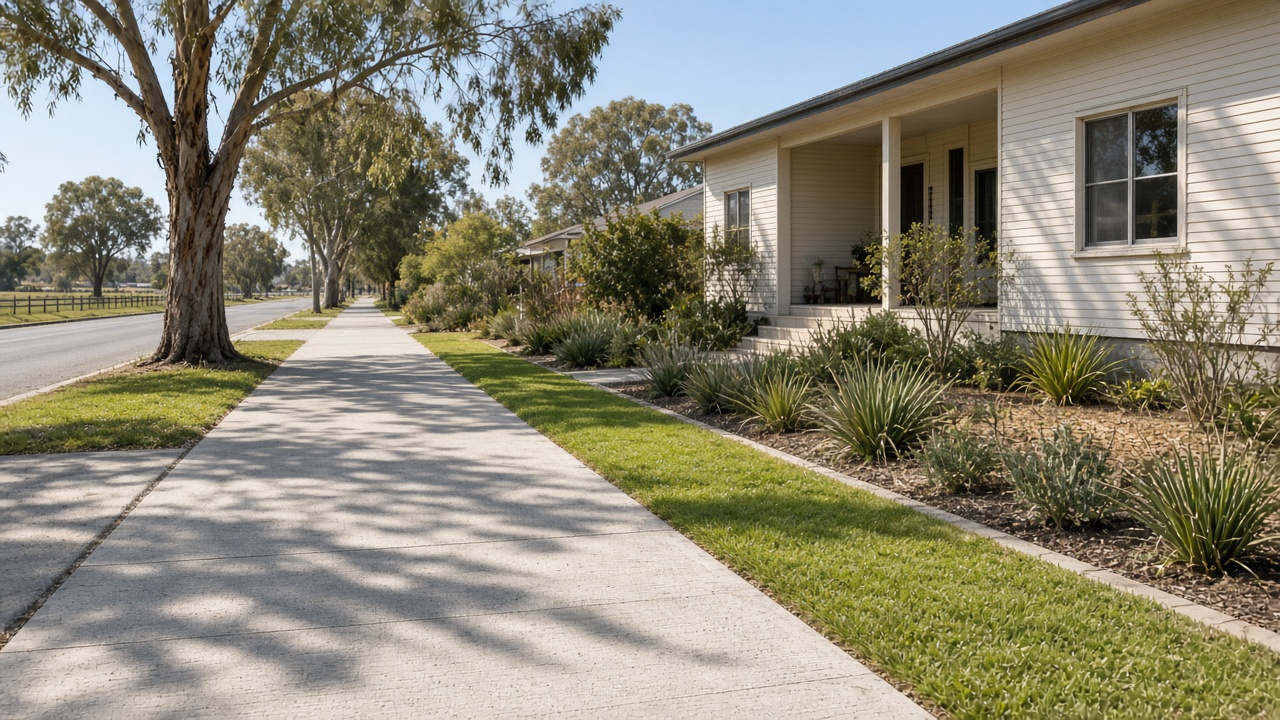
Concrete paths and footpaths in Koo Wee Rup
Paths and footpaths in Koo Wee Rup need sure footing, tidy edges and falls that do not leave a puddle at the gate after a night of rain.
Email: info@kooweerupconcreting.com.au
A path that is a pleasure to use in the wet
A path is a small slab, but it is the surface you use every day, often in the dark, often with an armful of shopping or a bin. We pour paths with a textured finish for grip, with joints and edges that stay neat, and with falls that shed water instead of holding it at a step. On a flat block, even a short path from the driveway to the front door needs that care, or you will be walking through a shallow pond all winter.
Width matters more than people think. A path that is too narrow next to a garden bed will have wet shoulders and will feel mean when two people pass. We will suggest a sensible width for the route, including a slightly wider landing at a door or a gate.
Front walks, side gates and bin runs
Front paths can take a more decorative finish — exposed aggregate or a coloured slab that matches the driveway. Side and bin paths are usually plain broomed concrete, sometimes with a small pad at the bins or the clothesline. We like those working paths to be easy to sweep and high enough that garden soil is not always spilling over the edge.
Where a path meets a driveway, we plan the joint so you do not get a trip or a cracked corner. Where it meets a public footpath or a crossover, we look at the levels so the meeting is legal and comfortable, not a step on the nature strip.
Council footpaths and the private path on your block
A path on your property is one kind of job. A footpath in the road reserve is another, and it has to follow the shire's requirements if it is in their land. We will be clear about which is which, and we will not treat a public footpath as a casual extension of a backyard pour. If your job includes both, the quote will say so.
Paths that feel like they belong to the house
A path is a small slab, and it is also the surface you use every day in the wet. In Koo Wee Rup that often means a run from the driveway to the front door, a side path to a clothesline, or a farm path between the house and a shed that is used in the dark with a torch and a bag of feed. Those jobs fail in quiet ways: a slight pond at the step, a lip that catches a heel, a broom that is too smooth when the frost is on it, or a meeting with an old porch that was never levelled honestly.
We set path widths to the way you actually walk, not only to a plan width that looked fine on a page. A bin path needs room for the bin and a person beside it. A side path between a fence and a wall needs enough width that you are not brushing the weatherboards. Where a path turns, we would rather give you a comfortable radius or a clean corner than a sharp pinch that becomes a mud shortcut.
Falls, steps and the meeting with the door
A path should shed water and still arrive at the door at a sensible height. On this flat ground that can take more thought than people expect, because there is not always a natural fall to steal. We will sometimes lift a path slightly, or introduce a shallow step, rather than run water toward the house. If an existing porch is already low, we will say so before we pour, because a pretty new path that wets the door is not a success.
Joints on a long, narrow path should be regular and square to the run, or planned at a turn, so they do not look like afterthoughts. We also watch tree roots and irrigation lines, because a neatly poured path that is then lifted by a nearby tree is a frustration we would rather talk about early.
Township frontages and public footpath meetings
Some properties in town meet a public footpath or a nature strip in a way that needs care. We will not casually pour over a public path, and we will not leave a trip at the boundary. If a short private path has to meet Council work, we will look at the levels and talk about who owns which part. A private path can still be a proper, sure-footed piece of work even when it is only a few metres long. Those small jobs are often the ones that make the house easier to live in every week.
Materials underfoot and the way a path is used at night
A path is often used with a basket, a child, or a torch. The finish should be honest about that. We like a light, even broom on most Koo Wee Rup paths, and we are careful at changes of direction so you do not get a step you only discover in the dark. If a path sits under a tree, we will talk about leaves, roots and cleaning, because a pretty line that then lifts is a poor weekly companion.
Where a path runs beside a driveway, we set the relationship so water does not sit in the joint and so a car does not break the path edge on a tight turn. Those two surfaces can be poured together or in sequence, but they should still belong to one set of levels. A cheap path poured later, thinner, and a little low is how a good driveway begins to look untidy at the side.
Koo Wee Rup soil, water and Cardinia Shire rules
Koo Wee Rup sits on land that was once a swamp, drained from the late nineteenth century so the township and the market gardens could exist. Under the grass you will often find peat, heavy clay, or a mix of the two, with a water table that can sit closer to the surface than it does in the hills. Peat can compress. Clay can shrink and swell with the seasons. A slab poured thin, straight onto that ground, will move with it.
We dig until we reach firm material, take out soft or wet soil, compact crushed rock in layers, set steel on chairs, and design falls so water leaves the house and the garage on this flat land. Winter rain can make compaction harder. A hot north wind can dry a finish too fast. We plan around both. Concrete inside your boundary rarely needs a council permit. Work in the road reserve — a crossover, a nature strip, a public footpath — can need Cardinia Shire's consent. A slab that will carry a building needs a building permit and, usually, engineering. Your quote spells out which of these apply.
How your Koo Wee Rup quote is put together
Every quote we send is written and itemised. It describes the area we measured, the excavation and where the spoil or old concrete will go, the compacted crushed-rock base, the slab thickness, the steel and how it will be supported, the finish, any sealer, and extras such as a drain, a step, a border or a new crossover. If Cardinia Shire or a building surveyor has to be involved, the quote names that rather than leaving it as a surprise.
The quote also describes the practical side of the pour: where a truck or pump would stand, how we protect gardens and fences, and how long the area needs to stay closed. If we think the ground may hide a problem — wet peat, an old slab, a pipe — we say so and explain how we would handle it. There are no prices on this website because two blocks in the same Koo Wee Rup street can need very different prep. The visit and the written quote cost you nothing.
What you get with Koo Wee Rup Concreting
Local to Koo Wee Rup 3981
We work the township first, then the hamlets and neighbouring Cardinia towns we actually drive to every week.
Built for peat, clay and flat ground
Deeper prep where the old swamp soil needs it, compacted bases, and falls that drain on land with almost no natural slope.
Free written quotes
Every job is itemised. No website rates, no pressure, and no charge to visit or to send the quote.
Shire-edge work handled clearly
Crossovers in the road reserve and any permit questions are named in the quote before we start.
Six steps to a finished job
- 1
Get in touch
Call, email, or send the form with a few photos of the area, the front of the property, and any tight gate.
- 2
Site visit
We measure, look at the ground, check levels and the crossover, and bring finish samples to hold against the house.
- 3
Written quote
You get an itemised quote covering digging, base, thickness, steel, finish, drainage and any shire or permit work.
- 4
Base and formwork
We remove failed concrete or topsoil, excavate soft material, compact the base, set the forms and place steel.
- 5
Pour and finish
Concrete is placed, levelled and finished, then protected while it cures in the week's weather.
- 6
Clean-up and care
We strip the forms, cut joints, take the rubble away, seal if it was quoted, and leave you care notes.
Paths and Footpaths questions
Can you match my existing driveway?
We can get close in colour and texture, especially if we know the original mix. An exact match to weathered concrete is not always possible, and we will be honest about that. Sometimes a deliberate contrast looks better than a near miss.
Do paths need the same base as a driveway?
They still need a sound, compacted base, especially on peat or wet clay, but the thickness and reinforcement are usually lighter than a driveway. We will not skip prep just because the strip is narrow.
Where we work
Other concreting services
Talk to a Koo Wee Rup concreter
We visit, measure and put it in writing for work in Koo Wee Rup 3981 and the Cardinia towns around it. Nothing on this site is priced, because no two blocks are the same.